
How to Choose a Wedding DJ in Omaha: 7 Honest Questions to Ask Before You Book
Your wedding DJ isn't just background music. They're the MC keeping your timeline on track, the person reading the room at 9 PM when energy starts to dip, and the one who either nails or fumbles your first dance. In a city like Omaha, where wedding season fills up fast and every vendor seems to have a slick website, knowing how to vet a DJ before you sign anything is genuinely important.
I've seen what happens when couples book a DJ based on price alone, or skip the hard questions because they liked the guy's vibe on a quick phone call. Don't be that couple. Ask these seven questions — every single one — before you put down a deposit.
Why the DJ Decision Matters More Than You Think
Photographers capture your day. Caterers feed your guests. But the DJ controls how your guests feel from the moment cocktail hour starts to the last song of the night. A good DJ knows when to slow things down, when to pick it back up, and how to handle the unexpected without you ever knowing something went sideways.
In Omaha's wedding market, you've got everything from solo hobby DJs to national entertainment companies with rotating rosters of contractors. The price range is wild, the quality range is even wilder, and the only way to know what you're actually getting is to ask the right questions.
Here they are.
Question 1: How Many Weddings Have You DJ'd, and How Many Were in Omaha?
This isn't about doubting someone's talent — it's about local knowledge. Omaha has its own venue quirks, its own vendor relationships, and its own crowd energy. A DJ who's worked The Acres in Gretna knows the barn acoustics. Someone who's played Joslyn Castle knows the room layout changes everything for sound setup. That local experience is hard to replace with raw talent.
Ask for specifics: How many total weddings? How many in the last 12 months? How many at your specific venue — or at venues similar to yours?
What good looks like: A confident, specific answer. "I've done 40+ weddings in the last two years, including several at your venue."
A red flag: Vague answers, pivoting to how long they've "been in the industry," or struggling to name any local venues they know well.
Question 2: Will YOU Be the DJ at Our Wedding?
This one catches people off guard, but it matters enormously. Some entertainment companies operate like staffing agencies — you meet with a sales rep or the owner, fall in love with them, sign the contract, and then a completely different DJ shows up on your wedding day.
That's not inherently wrong (some companies do have deep benches of talented DJs), but you deserve to know who you're actually booking and have some say in it.
Ask directly: "Will you personally be performing at our wedding? If not, can I meet or speak with the DJ who will be?"
What good looks like: Either a direct "yes, it'll be me" or a transparent conversation about their team and a willingness to connect you with whoever will be there.
A red flag: Deflection, vague assurances, or resistance to telling you who will actually show up.
Question 3: What's Your Backup Plan?
Equipment fails. People get sick. Life happens. Any DJ who's been doing this long enough has had a piece of gear go down mid-event, or has had to scramble at the last minute. The question isn't whether they've had problems — it's whether they have a real plan when something goes wrong.
Ask specifically: "If you get sick the week of our wedding, what happens? Do you have backup equipment on-site or in your vehicle?"
What good looks like: A clear, rehearsed answer. Redundant gear. A network of backup DJs they trust. A contract clause that addresses it.
A red flag: "That's never happened to me." (That's not a plan.) Or obvious discomfort with the question.
Question 4: How Do You Handle Guest Requests?
Every wedding has that one guest — maybe several — who makes a beeline for the DJ booth with a very specific, very off-vibe song request. How your DJ handles that moment says everything about their skill as a reader of the room.
You want someone who can honor the spirit of a request without blowing up the energy you've built. You don't want a DJ who either ignores every request (makes guests feel dismissed) or plays every request (turns your carefully planned vibe into karaoke night at a dive bar).
Ask: "How do you balance guest requests with the playlist and vibe we've discussed?"
What good looks like: A thoughtful answer about reading the room, queuing requests for the right moment, and honoring the couple's overall direction first.
A red flag: "I pretty much play whatever people ask" or "I don't really take requests." Both extremes are problems.
Question 5: How Customizable Is Our Playlist?
Your wedding music should feel like you — not like a preset "wedding playlist" from 2019. A great DJ will want to dig into your taste: what you love, what you can't stand, specific songs for key moments, and the general vibe you're going for across different parts of the night.
Ask: "How detailed can we get with our must-plays and do-not-plays? Do you use planning software that we can access?"
What good looks like: A clear process for gathering your preferences, a planning portal or questionnaire, and genuine enthusiasm about getting it right.
A red flag: "I usually just vibe off the crowd" with no process for learning your tastes — or a DJ who seems annoyed by the level of detail you want.
Note for multicultural or specialty weddings: If you're planning an Indian wedding, a bilingual ceremony, or an event with specific cultural music traditions, ask explicitly whether they have experience with that format. Not every DJ does, and that's okay — but you need to know upfront.
Question 6: What's Actually Included in Your Package?
DJ pricing in Omaha can range from a few hundred dollars to several thousand, and the gap often comes down to what's included vs. what's extra. Uplighting, MC services, a photo booth, cold spark machines, ceremony sound, cocktail hour coverage, additional hours — all of these are add-ons with some vendors and included with others.
Ask for a complete breakdown: "Can you walk me through exactly what's included in this package and what would cost extra?"
Compare packages line by line, not just by the bottom number. A DJ quoting $1,200 with ceremony sound, uplighting, and MC services included might be a better value than a $900 quote that adds those on separately.
What good looks like: A transparent, itemized breakdown. No resistance to explaining the details.
A red flag: Vague package descriptions, pressure to "just trust us," or surprise fees discovered after you've signed.
Question 7: Can I See Recent Reviews from Real Couples?
Google reviews, wedding directories, testimonials on their website — all of it matters, but recency matters most. A DJ who crushed it in 2019 may have changed their business model, their equipment, or their approach since then. Look for reviews from the last 12–18 months.
Ask: "Can you point me to your recent Google reviews? Do you have references from couples you've worked with in the last year?"
Also pay attention to what people say in reviews. "The dance floor was packed all night" tells you a lot more than "great DJ, highly recommend."
What good looks like: Easy access to recent, detailed reviews. Willingness to connect you with a past couple if you want to chat.
A red flag: Reviews that are mostly old, thin on detail, or suspiciously uniform. Or a DJ who seems put off by being asked.
Red Flags: When to Walk Away
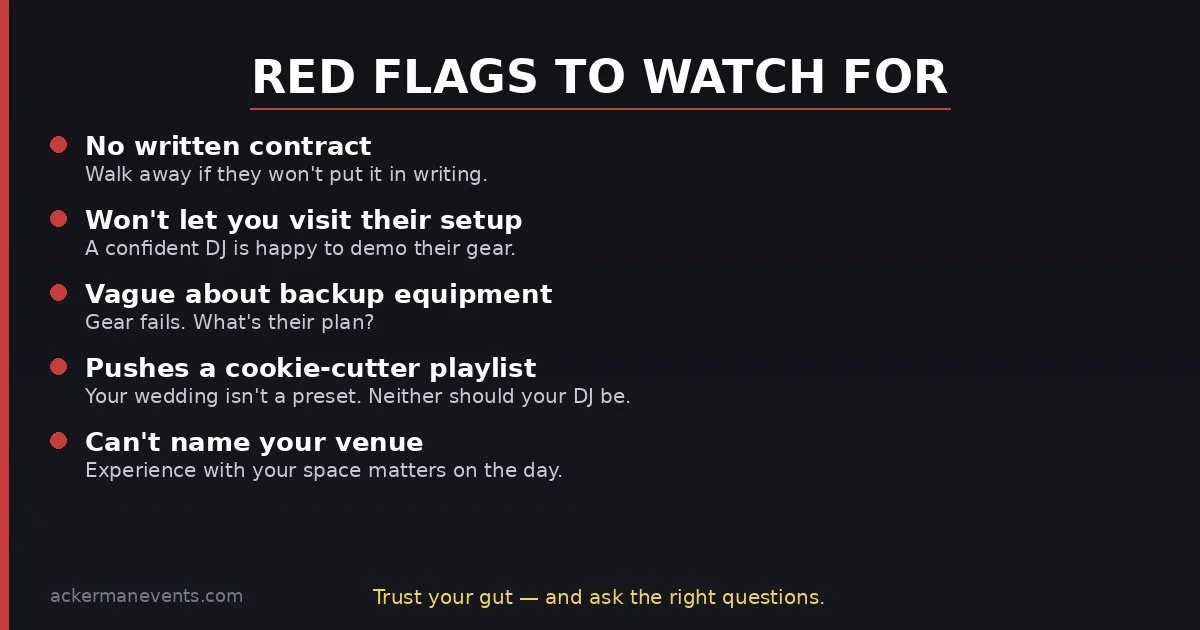
Beyond the seven questions, trust your gut on these warning signs:
No written contract. Full stop. A contract protects both of you. Walk away if they won't put it in writing.
Can't tell you their cancellation and refund policy. This should be easy and clear.
Reluctant to let you hear them mix or see their setup. A confident DJ welcomes this.
Heavily discounted pricing with no explanation. Cheap isn't always bad, but it usually means something's missing.
Can't name your venue or seems unfamiliar with Omaha's wedding market. Local knowledge matters.
What to Do With the Answers
Book the DJ who answers these questions confidently, specifically, and without making you feel like you're asking too much. Your wedding day is worth the due diligence, and the right vendor will respect you for doing it.
A few final tips:
Book early. Omaha's busiest wedding Saturdays (May–October) fill up 12–18 months out for the most in-demand DJs.
Get everything in writing. Song requests, timeline, package details, overtime rates — all of it.
Meet (or video call) before you sign. Chemistry matters. You're trusting this person to be a major presence at one of the most important days of your life.
One More Thing: We're Happy to Answer All of These

At Ackerman Events, we've built our business on transparent, honest conversations — exactly the kind this post is encouraging you to have with every DJ you consider. We serve Omaha, Lincoln, Council Bluffs, Papillion, Bellevue, and all of Eastern Nebraska and Western Iowa.
Whether you're planning a wedding, a corporate event, or a school dance, we'd love to talk through what you're envisioning. And yes — we'll answer every single question on this list.
[Get a free quote at ackermanevents.com]
Zach Ackerman is the owner and lead DJ at Ackerman Events, an Omaha-based entertainment company specializing in weddings, corporate events, and school dances. Ackerman Events offers DJ, MC, photo booth, uplighting, and specialty entertainment services across Eastern Nebraska and Western Iowa.